

People Remember Faces, Not Mission Statements
Why do companies still spend millions building a brand voice when the most powerful one is already on the payroll?
You probably can't recite Nvidia's mission statement. You might not even picture its founder. But inside the industry, Jensen Huang is unmistakable: the black leather jacket, the stage presence, the way he talks about his own company like a fan. As Nvidia became one of the most valuable companies on earth, his face went with it. The person and the brand rose together.
Why do companies still spend millions building a brand voice when the most powerful one is already on the payroll?
You probably can't recite Nvidia's mission statement. You might not even picture its founder. But inside the industry, Jensen Huang is unmistakable: the black leather jacket, the stage presence, the way he talks about his own company like a fan. As Nvidia became one of the most valuable companies on earth, his face went with it. The person and the brand rose together.
Authentic beats polished
People trust real personalities more than polished brands.
Younger audiences especially have grown sceptical of scripted corporate messaging and copy-paste LinkedIn posts. The flood of AI-generated content is making it worse. When every company sounds the same, blending in is the risk.
So what does authentic actually look like? Not a content calendar of safe takes. It means a leader saying something only they would say, with a point of view they'd defend in a room. A real opinion, in a real voice, attached to a real name.
Authentic beats polished
People trust real personalities more than polished brands.
Younger audiences especially have grown sceptical of scripted corporate messaging and copy-paste LinkedIn posts. The flood of AI-generated content is making it worse. When every company sounds the same, blending in is the risk.
So what does authentic actually look like? Not a content calendar of safe takes. It means a leader saying something only they would say, with a point of view they'd defend in a room. A real opinion, in a real voice, attached to a real name.
Trust is won before the pitch
Visibility no longer touches just marketing or PR. It shapes recruiting, sales and partnerships alike.
Start with recruiting, where the evidence is strongest. A Brunswick study found that 82% of employees check a CEO's online presence before deciding whether to join a company (Source: Brunswick, 2022). The people you most want to hire are reading you before you ever meet them.
The same logic runs through sales and partnerships. Buyers research the person before the pitch. Partners back people they can read. You can automate outreach. You can’t automate trust.
A personal brand can also divide opinion, and that's the trade-off worth naming. The most visible founders are rarely universally liked. But a clear voice that some people reject will always beat a safe one nobody remembers.
You already have a personal brand
Everyone does. Through social media, interviews, press, and the way you show up in a room, you leave footprints. The only question is whether you're shaping them on purpose.
A strategic personal brand lets a leader tell their own story directly, instead of leaving it to advertising or the press.
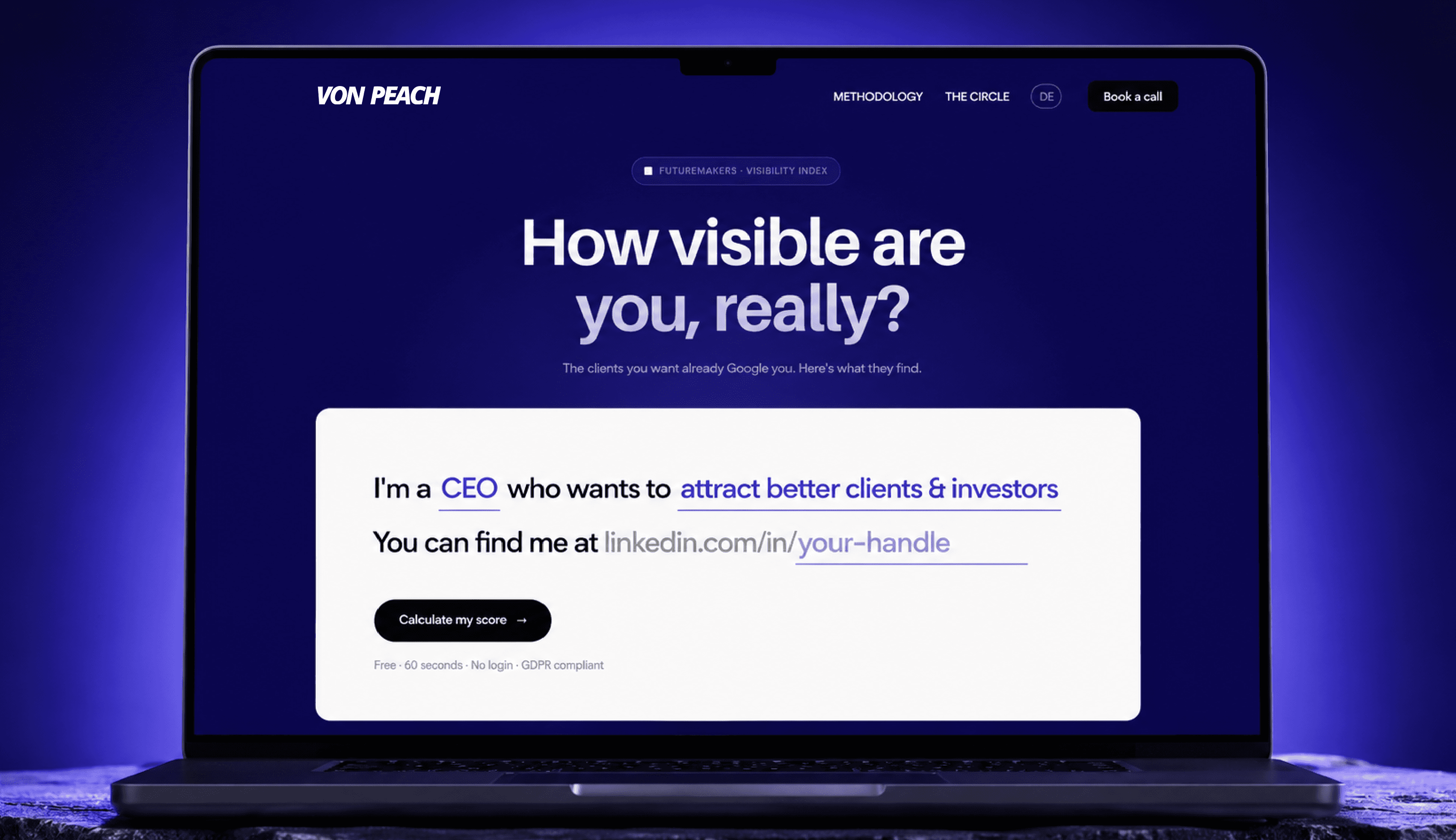
That's where agencies like Von Peach come in. Not by inventing personas, but by building strategies that make the people behind a company recognisable and their values heard.
So the names that win the next decade won't be the loudest in the room. They'll be the ones with a face you'd recognise and a voice you'd trust. Not the loudest. The clearest.
Trust is won before the pitch
Visibility no longer touches just marketing or PR. It shapes recruiting, sales and partnerships alike.
Start with recruiting, where the evidence is strongest. A Brunswick study found that 82% of employees check a CEO's online presence before deciding whether to join a company (Source: Brunswick, 2022). The people you most want to hire are reading you before you ever meet them.
The same logic runs through sales and partnerships. Buyers research the person before the pitch. Partners back people they can read. You can automate outreach. You can’t automate trust.
A personal brand can also divide opinion, and that's the trade-off worth naming. The most visible founders are rarely universally liked. But a clear voice that some people reject will always beat a safe one nobody remembers.
You already have a personal brand
Everyone does. Through social media, interviews, press, and the way you show up in a room, you leave footprints. The only question is whether you're shaping them on purpose.
A strategic personal brand lets a leader tell their own story directly, instead of leaving it to advertising or the press.
That's where agencies like Von Peach come in. Not by inventing personas, but by building strategies that make the people behind a company recognisable and their values heard.
So the names that win the next decade won't be the loudest in the room. They'll be the ones with a face you'd recognise and a voice you'd trust. Not the loudest. The clearest.